Canada remains one of the world’s leading study abroad destinations in 2026, ranking among the top five countries hosting international students. According to the Canadian Bureau for International Education, Canada hosted approximately 11% of globally mobile international students. Indian students accounted for around 31% of Canada’s international student population at the end of 2025, making India its largest source country. Students who choose to study in Canada benefit from diverse programmes in business, engineering, healthcare and technology, along with research opportunities, multicultural communities and potential career pathways after graduation. These advantages make Canada an appealing destination for Indian students seeking international exposure and professional development.
Why Study in Canada?
Canada is one of the world’s most preferred study destinations, offering globally recognized education, excellent career opportunities, and an outstanding quality of life. Here are the top reasons why international students choose Canada for higher education:
High-Quality Education at World-Class Institutions
Canadian degrees, diplomas, and certificates are recognized and respected worldwide, including in the UK, the US, and other Commonwealth countries.
Wide Range of Programs and Courses
Canadian institutions offer over 10,000 undergraduate, postgraduate, diploma, certificate, and professional programs across diverse disciplines.
Affordable Cost of Education
Compared with other popular study destinations such as the United States, the United Kingdom, and Australia, Canada offers high-quality education at a more affordable cost.
Multiple Scholarship Opportunities
International students can benefit from a wide range of scholarships, bursaries, and financial aid offered by the Canadian government, universities, and private organizations.
Safe and Peaceful Environment
With its welcoming communities, low crime rates, and high quality of life, Canada is consistently recognized as one of the safest countries in the world.
Student-Friendly Visa Process
With clear eligibility requirements and streamlined application procedures Canada offers a transparent and well-defined study permit process for eligible international students.
Top Universities in Canada for International Students
Canada is home to a world-class education system, with a wide range of universities and colleges offering globally recognised qualifications. One of the major advantages of choosing to study in Canada is that students get to choose from over 220 publicly funded and private universities and more than 200 publicly funded colleges and institutes, along with several specialised institutions approved by provincial education authorities.
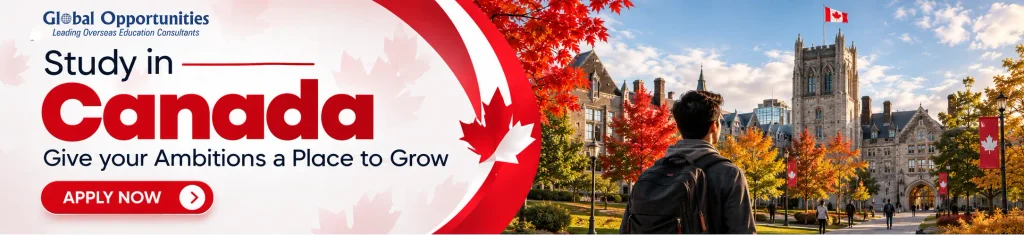
List of Top Courses to Study in Canada
For Indian and international students, popular UK study options include Computer Science, Business and Management, Engineering, Data Science and Artificial Intelligence etc. Computing and business-related subjects are particularly prominent among international students.
Bachelor's Course
| Bachelors in Computer Science in Canada | Bachelors in Tourism Management in Canada |
| Bachelors in IT in Canada | Bachelors in Psychology in Canada |
| Bachelors in Data Science in Canada | Bachelors in Sociology in Canada |
| Bachelors in Artificial Intelligence in Canada | Bachelors in International Relations in Canada |
| Bachelors in Cybersecurity in Canada | Bachelors in Political Science in Canada |
| Bachelors in Software Engineering in Canada | Law Courses in Canada for Indian Students |
| Bachelors in Information Systems in Canada | Bachelors in Criminology in Canada |
| Bachelors in Computer Engineering in Canada | Bachelors in Journalism in Canada |
| Bachelors in Robotics in Canada | Bachelors in Mass Communication in Canada |
| Bachelors in Engineering in Canada | Bachelors in Media and Communication in Canada |
| Bachelors in Mechanical Engineering in Canada | Film Courses in Canada for Indian Students |
| Bachelors in Civil Engineering in Canada | Bachelors in Graphic Design in Canada |
| Bachelors in Electrical Engineering in Canada | Bachelors in Architecture in Canada |
| Bachelors in Electronics Engineering in Canada | Bachelors in Interior Design in Canada |
| Bachelors in Chemical Engineering in Canada | Bachelors in Fine Arts in Canada |
| Bachelors in Aerospace Engineering in Canada | Bachelors in Animation in Canada |
| Bachelors in Biomedical Engineering in Canada | Bachelors in Biotechnology in Canada |
| Bachelors in Environmental Engineering in Canada | Bachelors in Biology in Canada |
| Bachelors in Industrial Engineering in Canada | Bachelors in Biochemistry in Canada |
| Bachelors in Mechatronics in Canada | Bachelors in Chemistry in Canada |
| BBA in Canada for Indian Students | Bachelors in Physics in Canada |
| Bachelors in Business Management in Canada | Bachelors in Mathematics in Canada |
| Bachelors in International Business in Canada | Bachelors in Environmental Science in Canada |
| Bachelors in Finance in Canada | Bachelors in Food Science in Canada |
| Bachelors in Accounting in Canada | Bachelors in Nursing in Canada |
| Bachelors in Economics in Canada | Pharmacy Courses in Canada for Indian Students |
| Bachelors in Marketing in Canada | Bachelors in Public Health in Canada |
| Bachelors in Digital Marketing in Canada | Physiotherapy Courses in Canada for Indian Students |
| Bachelors in Business Analytics in Canada | Bachelors in Nutrition in Canada |
| Bachelors in HR Management in Canada | Bachelors in Health Sciences in Canada |
| Bachelors in Supply Chain Management in Canada | Veterinary Courses in Canada for Indian Students |
| Bachelors in Logistics in Canada | Bachelors in Agriculture in Canada |
| Bachelors in Entrepreneurship in Canada | Bachelors in Education in Canada |
| Bachelors in Hospitality Management in Canada | Bachelors in Social Work in Canada |
| Hotel Management Courses in Canada | Environmental Studies Courses in Canada |
Master's Course
| Masters in Computer Science in Canada | Masters in Economics in Canada |
| Masters in Data Science in Canada | Masters in Banking and Finance in Canada |
| Masters in Artificial Intelligence in Canada | Masters in Psychology in Canada |
| Masters in IT in Canada | MSW in Canada for Indian Students |
| Masters in Cybersecurity in Canada | Masters in International Relations in Canada |
| Masters in Data Analytics in Canada | Masters in Political Science in Canada |
| Masters in Business Analytics in Canada | Masters in Public Policy in Canada |
| Masters in Information Systems in Canada | MPA in Canada for Indian Students |
| Masters in Software Engineering in Canada | LLM in Canada for Indian Students |
| Masters in Computer Engineering in Canada | Masters in Criminology in Canada |
| Masters in Machine Learning in Canada | Masters in Journalism in Canada |
| Masters in Robotics in Canada | Masters in Mass Communication in Canada |
| Masters in Mechanical Engineering in Canada | Masters in Communication in Canada |
| Masters in Civil Engineering in Canada | Masters in Film in Canada |
| Masters in Electrical Engineering in Canada | Masters in Architecture in Canada |
| Masters in Electronics Engineering in Canada | Masters in Urban Planning in Canada |
| Masters in Chemical Engineering in Canada | Masters in Graphic Design in Canada |
| Masters in Aerospace Engineering in Canada | Masters in Animation in Canada |
| Masters in Biomedical Engineering in Canada | Masters in Biotechnology in Canada |
| Masters in Environmental Engineering in Canada | Masters in Biomedical Sciences in Canada |
| Masters in Industrial Engineering in Canada | Masters in Biology in Canada |
| Masters in Mechatronics in Canada | Masters in Chemistry in Canada |
| Masters in Engineering Management in Canada | Masters in Physics in Canada |
| Masters in Renewable Energy in Canada | Masters in Mathematics in Canada |
| MBA in Canada for Indian Students | Masters in Environmental Science in Canada |
| Masters in Management in Canada | Masters in Sustainability in Canada |
| Masters in Finance in Canada | Masters in Public Health in Canada |
| Masters in Accounting in Canada | Masters in Healthcare Management in Canada |
| Masters in Professional Accounting in Canada | Masters in Nursing in Canada |
| Masters in Marketing in Canada | Masters in Pharmacy in Canada |
| Masters in Digital Marketing in Canada | Masters in Nutrition in Canada |
| Masters in International Business in Canada | Masters in Education in Canada |
| Masters in HR Management in Canada | Masters in Teaching in Canada |
| Masters in Supply Chain Management in Canada | Masters in Higher Education in Canada |
| Masters in Logistics Management in Canada | Masters in Hospitality Management in Canada |
| Masters in Project Management in Canada | Masters in Tourism Management in Canada |
| Masters in FinTech in Canada | Masters in Real Estate in Canada |
Study in Canada Fees for Indian Students
The total expense of studying in Canada is determined by the university, degree program, geographical location and way of life.
The cost of studying in Canada depends on the type of programme, institution, location, and lifestyle. International students should budget for tuition fees as well as accommodation, food, transportation, health insurance, and other living expenses. The figures below can be used as indicative ranges for planning purposes.
|
Expense |
Typical Cost for International Students (CAD) |
Approx. Cost in INR |
|
Undergraduate tuition fees |
CAD 15,000–40,000 per year |
₹10.35–27.60 lakh per year |
|
Postgraduate tuition fees |
CAD 10,000–35,000 per year |
₹6.90–24.15 lakh per year |
|
Diploma/Certificate programmes |
CAD 10,000–25,000 per year |
₹6.90–17.25 lakh per year |
The cost of living in Canada varies depending on the city, accommodation type, lifestyle, and spending habits of a student. Major cities such as Toronto and Vancouver generally have higher living costs, while smaller cities can be more affordable.
|
Living Expense |
Estimated Monthly Cost (CAD) |
|
Accommodation |
CAD 600–2,000 |
|
Food & Groceries |
CAD 300–600 |
|
Transportation |
CAD 80–150 |
|
Utilities & Internet |
CAD 100–200 |
|
Health Insurance |
CAD 50–100 |
|
Mobile Phone |
CAD 40–80 |
|
Personal & Entertainment Expenses |
CAD 100–300 |
|
Estimated Total |
CAD 1,270–3,430 per month |
Documents Required to Study in Canada
Students applying for a Canadian study permit generally need a valid passport, Letter of Acceptance (LOA) from a designated learning institution, Provincial/Territorial Attestation Letter (PAL/TAL) where applicable, and proof of sufficient funds. Other documents may include. Have a look at full list:
- Completed application form for your chosen university or college
- Academic transcripts and certificates (Class X, Class XII, and degree transcripts for postgraduate applicants)
- Statement of Purpose (SOP) explaining your choice of course and institution
- Letters of Recommendation (LORs), typically two to three, from academic or professional referees
- Updated resume/CV, particularly for postgraduate and MBA applications
- English language proficiency test scores (IELTS, TOEFL, or PTE)
- Standardized test scores where required (GRE for many master’s programs, GMAT for MBA)
- Valid passport
- Proof of financial support bank statements, a Guaranteed Investment Certificate (GIC), or an education loan sanction letter
- Letter of Acceptance from a Designated Learning Institution (DLI)
- Provincial or Territorial Attestation Letter (PAL/TAL), where your level of study requires one
- Passport-sized photographs as per Canadian visa specifications
- Medical examination report, where applicable
- Statutory Declaration of Financial Support and proof of relationship, if a family member is sponsoring your studies
Scholarships to Study in Canada for Indian Students
Canada offers scholarships to study in Canada for Indian students through three channels: the Canadian government, provincial governments, and individual universities.
Canada Graduate Scholarships (Master’s and Doctoral): The federal government’s flagship research scholarships, now issued through the harmonised Canada Research Training Awards Suite.
Ontario Graduate Scholarship (OGS): For master’s and PhD students at Ontario universities, typically valued at roughly CAD 5,000–15,000 per academic term depending on the institution.
Shastri Indo-Canadian Institute Scholarships: Bilateral India-Canada research funding, valued at roughly CAD 5,000–15,000, aimed specifically at graduate and research-level applicants working on India-Canada academic collaboration.
University-specific entrance scholarships: Most Canadian universities offer automatic or application-based entrance scholarships for high-achieving international undergraduates.
Mitacs Globalink and the Canada-India Talent and Innovation Strategy: A newer, India-specific initiative launched in 2026 offering funded research placements and undergraduate exchange positions; worth checking for STEM-focused applicants given how recently it launched.
Canada Intakes 2027
Canadian universities and colleges generally offer three major intakes for international students in 2027: Winter (January), Summer (May), and Fall (September). The availability of each intake depends on the institution, programme and seat availability. Fall is a major admission period, offering a broad range of undergraduate and postgraduate programmes.
Winter Intake (January 2027)
Classes generally begin in January. This intake is suitable for students who want to start their studies early in the year. Applications often open several months in advance, and some university deadlines may already have passed.
Summer Intake (May–July 2027)
This intake offers admission to selected programmes at participating Canadian universities and colleges. Course availability is generally more limited than in the Fall intake.
Fall Intake (September 2027)
This is a major admission intake in Canada, offering a broad selection of undergraduate and postgraduate programmes. It is suitable for students seeking more course options and potential scholarship opportunities.
Eligibility Criteria to Study in Canada
Indian students planning to study in the UK need to meet academic, English-language, financial and visa requirements. The exact criteria vary by university, course and level of study.
-
Undergraduate Programmes: Students generally need to complete Class 12 from a recognised board, meeting the university’s minimum percentage and subject prerequisites.
-
Postgraduate Programmes: Applicants typically require a recognised bachelor’s degree in a relevant field. Some programmes may require a minimum GPA or specific prerequisite subjects.
-
Diploma and Certificate Programmes: Students generally need to complete Class 12 or meet the institution’s specified entry requirements.
-
Additional Requirements: Certain courses, such as engineering, healthcare and management, may require entrance tests, a portfolio, relevant work experience or other supporting documents.
-
IELTS Academic: Many institutions require an overall score of approximately 6.0–6.5 for undergraduate admission and 6.5–7.0 for postgraduate programmes.
-
PTE Academic: Some institutions accept scores around 55–65 or higher, depending on the course.
-
TOEFL iBT: Many universities accept scores of approximately 80–100, depending on the programme and institution.
-
Duolingo English Test: Some institutions accept scores around 105–120, subject to their admission policies.
-
Alternative Proof of English: Certain institutions may offer exemptions based on previous education in English or accept other approved qualifications.
Important: These are general guidelines, not universal minimums. Exact academic requirements and English-language scores vary by institution, study level and programme. Meeting admission criteria does not automatically guarantee a Canadian study permit.
Canada Student Visa Requirements for Indian Students
Indian students planning to study in Canada must obtain the appropriate student visa/study permit before travelling. For more details, read below:
Letter of Acceptance
An official admission letter from a Designated Learning Institution (DLI) is the first requirement no study permit application can proceed without it.
Provincial Attestation Letter
A provincial or territorial attestation letter is generally required for eligible study permit applicants, subject to current exemptions. Quebec has separate requirements.
Proof of Financial Support
Evidence that you can pay tuition fees, living expenses and transportation costs. Accepted evidence may include bank statements, education loans, scholarships or sponsor documents.
Academic Documents
Educational certificates, transcripts, mark sheets and other documents required to support your application and study plans.
English Language Test Results
IELTS Academic, TOEFL, PTE or another test result if required by your institution. English test results are not a universal standalone requirement for every study permit application.
SOP or Letter of Explanation
Explain your study objectives, choice of course and institution, educational background, and how the programme aligns with your future plans.
Valid Passport and Photographs
A valid passport or travel document and photographs that meet the application requirements.
Medical Examination & Police Certificate
A medical examination may be required depending on your circumstances. A police certificate may also be requested in specific cases.
Study Permit Application and Biometrics
Complete the online application, pay the applicable fees and provide biometrics when instructed. Additional documents may be requested by the immigration authorities.
Exam Requirements to Study in Canada
The exams required to study in Canada depend on the level of study, university or college, and chosen programme. International students may need to demonstrate English or French language proficiency, while some programmes may also require subject-specific or standardised tests Students should check the exact requirements of their chosen institution before applying.
Top Student Cities in Canada
Canada is home to several student-friendly cities that combine internationally recognised universities, diverse communities and opportunities for professional development.
|
City |
Advantages for International Students |
|
Toronto |
Access to a broad range of universities and programmes; exposure to major employers; extensive networking opportunities; multicultural environment; strong public transport and part-time work opportunities |
|
Montréal |
Relatively lower living costs than Toronto and Vancouver; opportunity to experience both English and French; vibrant cultural life; strong university ecosystem; access to technology, research and creative industries |
|
Vancouver |
Milder winters than many Canadian cities; access to outdoor activities; proximity to Asia-Pacific markets; opportunities in technology, film, clean technology and business; multicultural student environment |
|
Ottawa |
Exposure to government and public-sector careers; opportunities in technology and research; bilingual environment; relatively manageable city size; strong cultural and international community |
|
Calgary |
Career exposure in energy, engineering, technology and business; access to outdoor recreation; comparatively lower accommodation costs than Toronto and Vancouver; growing employment ecosystem |
|
Edmonton |
Opportunities in research, healthcare, engineering and technology; comparatively affordable accommodation; extensive parks and recreational spaces; student-friendly environment. |
|
Halifax |
Smaller and more community-oriented student environment; lower living costs than Canada’s largest cities; access to universities and research institutions; opportunities to explore Atlantic Canada’s economy. |
|
Waterloo |
Strong exposure to technology and innovation; co-op and work-integrated learning opportunities; proximity to major technology employers; relatively smaller student-focused community. |
|
Québec City |
Lower accommodation costs; opportunity to develop French-language skills; strong cultural experience; access to education and public-sector opportunities. |
|
Victoria |
Mild weather; attractive surroundings and outdoor activities; quieter study environment; access to universities and a close-knit student community. |
Career Opportunities After Studying in Canada
Canada offers international students access to a diverse employment market across technology, healthcare, engineering, finance, business, and other growing sectors. Studying in major cities can also provide opportunities to build professional networks through internships, co-op programmes and industry events:
| Job Role | Average Annual Salary (CAD) |
| Software Engineer | CAD 117,500 |
| Data Analyst | CAD 93,900 |
| Registered Nurse | CAD 90,000 |
| Accountant | CAD 84,000 |
| Business Analyst | CAD 85,000 |
| Mechanical Engineer | CAD 91,000 |
| Civil Engineer | CAD 88,000 |
| Marketing Manager | CAD 100,000 |
| Financial Analyst | CAD 85,000 |
| Human Resources Manager | CAD 100,000 |
| Cybersecurity Analyst | CAD 105,000 |
| Project Manager | CAD 100,000 |
Why Choose Global Opportunities to Study Abroad in Canada?
Global Opportunities supports students throughout their Canada study-abroad journey, from shortlisting suitable universities and courses to application and visa guidance. Our counsellors help students understand admission requirements, identify relevant scholarships and plan their applications according to intake deadlines:
- With 18 branches across India, Global Opportunities gives you face-to-face counselling wherever you’re based, backed by a dedicated Canada desk.
- We handle university shortlisting, SOP and LOR guidance, GIC and financial documentation, and visa filing under one roof, with counsellors who work Canada applications daily and know which documentation gaps trigger delays.
- Get personalised guidance to choose a Canadian university and course aligned with your academic background and career goals.
- Receive support at different stages of your study-abroad journey, from selecting a course to preparing for your departure.
Top Study Abroad Countries for Indian Students
There is no single destination that suits every academic plan. Students should compare countries according to the programmes available, university requirements and how those options relate to their individual study objectives.
Accreditation




Read Why Students Choose Global Opportunities
Read genuine reviews from students who were connected with the Global Opportunities and learn about their experience of researching universities, preparing applications and planning their next academic step.
Aafiya
Sahaj Ghumman
Vansh Jain
Frequently Asked Questions
Can I study in Canada without IELTS?
Some universities accept alternative English tests (TOEFL, PTE) or, for certain undergraduate programmes, a strong Class XII English can also be given a priority over English proficiency tests. But this varies by institution, so confirm with your specific university rather than assuming it applies everywhere.
Is Canada good for international students?
Yes, by most standard measures safety, multicultural campuses, work rights during study, and 25 Canadian universities ranked among the world’s best in the QS World University Rankings 2024, one can conclude that Canada is good for international students.
Is Canada good for Indian students?
Yes India remains the largest source country for international students in Canada, supported by established Indian communities in cities like Toronto, Brampton, Surrey and Vancouver, familiar cuisine and cultural infrastructure, and a straightforward English-medium system.
Is Canada expensive for international students?
Canada can be a significant investment for international students, with costs varying by university, programme, city and lifestyle. Tuition fees are generally higher for international students, while living expenses are typically greater in cities such as Toronto and Vancouver. However, scholarships, affordable accommodation options and careful budgeting can help manage overall costs.
What are the cheapest courses to study in Canada?
College diplomas are the lowest-cost route, generally CAD 7,000–22,000 per year, well below university tuition. Within universities, arts, humanities and social science postgraduate programmes tend to cost less than engineering, business or medicine.
Which course is best to study in Canada?
There’s no single “best” course; the right choice depends on your academic background, budget, and career goal. Business and management, computer science, engineering and data-related fields currently offer the strongest combination of programme availability and post-study job demand.
How can I study in Canada after 12th?
Apply directly to a bachelor’s degree if you meet the 70% aggregate benchmark most universities set, or to a diploma/advanced diploma programme (typically 50–60% aggregate).
How do I apply to universities in Canada?
Shortlist programmes and institutions matching your academic profile and budget, prepare your SOP, LORs, transcripts and English test scores, apply directly through each university’s admissions portal (Canada has no single centralised undergraduate application system like UCAS), and await your Letter of Acceptance before starting your study permit application.
How long does it take to get admission in Canada?
This varies by institution and intake, but most universities take four to eight weeks to process a complete application. Applying well ahead of the Fall intake deadline (typically 4–6 months in advance) gives you time to also secure a PAL, if required, and complete your study permit process.
When should I apply to study in Canada?
For the Fall (September) intake, most students should apply between October and March of the preceding year; earlier applications have a better shot at scholarships and give more runway for the PAL and study permit process. Winter and Summer intakes have earlier or later windows depending on the institution.