About Queen’s University Belfast
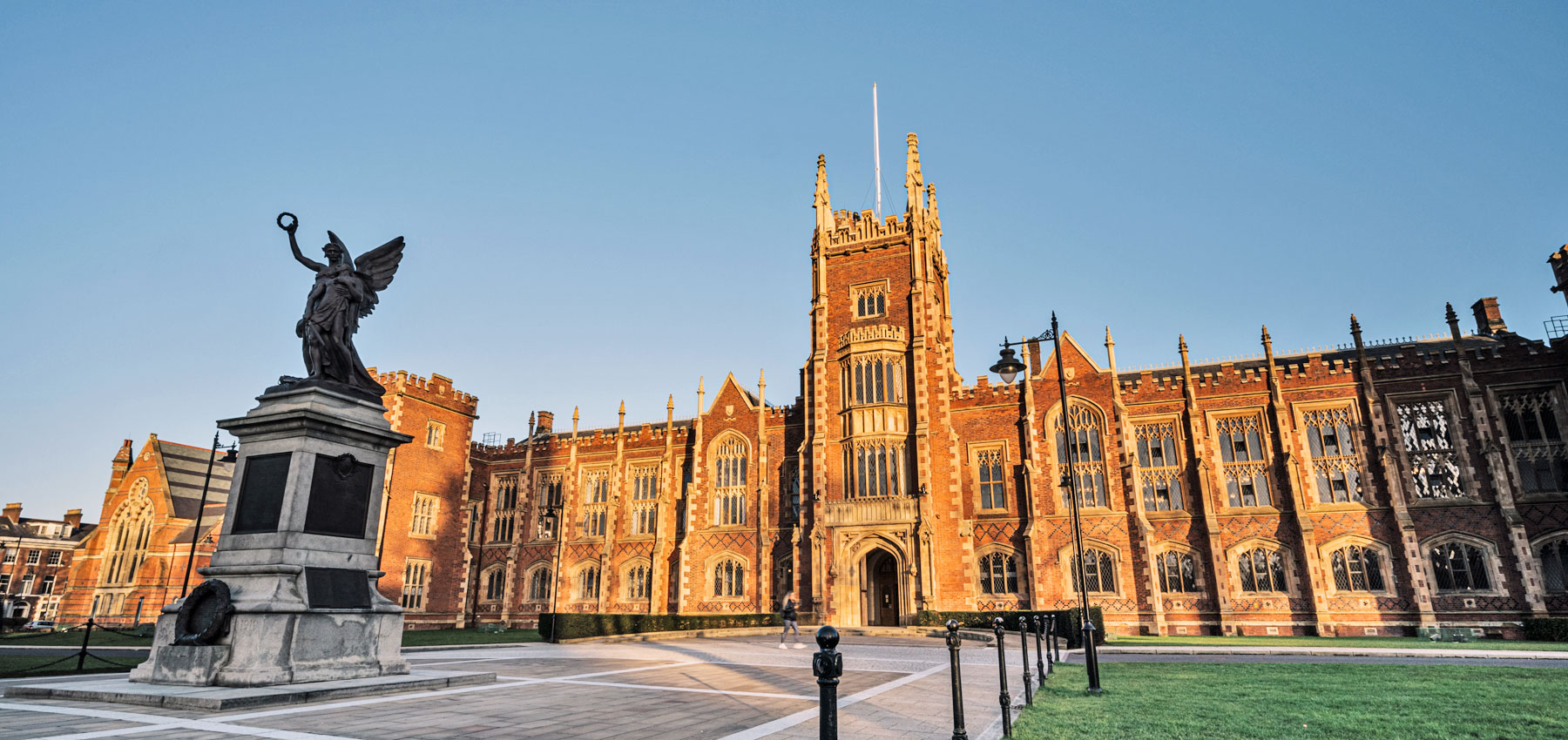
Founded in 1845, Queen’s is the ninth-oldest university in the UK and has been associated with the Russell Group since 2006. Its research credentials are genuinely strong for a university outside the traditional top tier: 99% of research submitted in the 2021 Research Excellence Framework was rated world-leading or internationally excellent, and Queen’s ranks 13th in the UK for research intensity.
More than 25,000 students study here, including over 4,000 international students from more than 90 countries. It is a compact, less anonymous university and centred on a single walkable campus in South Belfast rather than scattered across a major city.
If you are considering studying at Queen's University Belfast, this page covers what that actually means for an Indian applicant: what the degree costs in one of the UK’s cheapest major student cities, who gets in, and where Queen’s specifically earns its reputation rather than just borrowing the Russell Group label.
Queen’s University Belfast Ranking
Queen’s University Belfast just posted a 25-place climb in the QS World University Rankings, rising to 174th: its highest position in the university’s history. Read about the other ranking as well:
| Ranking Organisation | Position | Year |
| QS World University Rankings | 174th (up from 199th) | 2027 |
| Times and Sunday Times Good University Guide (UK) | 21st, #1 in Northern Ireland | 2026 |
| Complete University Guide: Research Intensity (UK) | 13th | 2027 |
| Complete University Guide : Graduate Prospects (UK) | 11th | 2027 |
Queen’s University Belfast Courses for Indian Students
Indian applicants at Queen’s cluster heavily around Business, Engineering, Computer Science, and Pharmacy not by accident, since these are exactly the subjects where Queen’s subject-level rankings and employer reputation are strongest.
Undergraduate Courses
| Course | Qualification | Duration |
| Aerospace Engineering | BEng | 3 years |
| Aerospace Engineering Sandwich | BEng | 4 years |
| Anthropology and Sociology | BA | 3 years |
| Anthropology and Spanish | BA | 4 years |
| Applied Mathematics and Physics | BSc | 3 years |
| Archaeology | BA | 3 years |
| Archaeology with French | BA | 4 years |
| Architecture | BSc | 3 years |
| Audio Engineering | BSc | 3 years |
| Biochemistry | BSc | 3 years |
| Biochemistry with Professional Studies | BSc | 4 years |
| Biomedical Science | BSc | 3 years |
| Business Economics | BSc | 3 years |
| Business Information Technology | BSc | 4 years |
| Business Management with Placement | BSc | 4 years |
| Civil Engineering | BEng | 3 years |
| Civil Engineering Year in Industry | BEng | 4 years |
| Computer Engineering | BEng | 3 years |
| Computer Engineering with Year in Industry | BEng | 4 years |
| Dentistry | BDS | 5 years |
| Drama | BA | 3 years |
| Drama and English | BA | 3 years |
| Economics | BSc | 3 years |
| Economics and Accounting | BSc | 3 years |
| Economics with French | BSc | 4 years |
| Economics with Spanish | BSc | 4 years |
| Education Studies | BA | 3 years |
| Electrical and Electronic Engineering | BEng | 3 years |
| Electrical and Electronic Engineering Sandwich | BEng | 4 years |
| English | BA | 3 years |
| English and Irish | BA | 3 years |
| English and Linguistics | BA | 3 years |
| English and Philosophy | BA | 3 years |
| English and Politics | BA | 3 years |
| English and Sociology | BA | 3 years |
| English and Spanish | BA | 4 years |
| Environmental Management | BSc | 3 years |
| Environmental Management with Professional Studies | BSc | 4 years |
| Film Studies and Production | BA | 3 years |
| Film and Theatre Making | BA | 3 years |
| Finance with a Year in Industry | BSc | 4 years |
| Financial Risk Management with a Year in Industry | BSc | 4 years |
| Games Technologies | BSc | 3 years |
| Geography | BA | 3 years |
| Geography | BSc | 3 years |
| Geography with a Language | BSc | 4 years |
| History | BA | 3 years |
| History and International Relations | BA | 3 years |
| History and Philosophy | BA | 3 years |
| History and Politics | BA | 3 years |
| History and Sociology | BA | 3 years |
| History and Spanish | BA | 4 years |
| Human Biology | BSc | 3 years |
| Irish | BA | 3 years |
| Irish and Broadcast Production | BA | 3 years |
| Marine Biology | BSc | 3 years |
| Marine Biology with Professional Studies | BSc | 4 years |
| Mathematics | BSc | 3 years |
| Mechanical Engineering | BEng | 3 years |
| Mechanical Engineering Sandwich | BEng | 4 years |
| Pharmaceutical Sciences | BSc | 3 years |
| Pharmaceutical Sciences (Sandwich) | BSc | 4 years |
| Philosophy | BA | 3 years |
| Philosophy and Politics | BA | 3 years |
| Physics | BSc | 3 years |
| Physics with Astro-Physics | BSc | 3 years |
| Physics with French | BSc | 4 years |
| Physics with Medical Applications | BSc | 3 years |
| Physics with Spanish | BSc | 4 years |
| Planning, Environment and Development | BSc | 3 years |
| Politics | BA | 3 years |
| Politics, Philosophy and Economics | BA | 3 years |
| Politics and Sociology | BA | 3 years |
| Politics and Spanish | BA | 4 years |
| Sociology | BA | 3 years |
| Spanish | BA | 4 years |
| Spanish and Portuguese | BA | 4 years |
Postgraduate Courses
| Course | Qualification | Duration |
| Aerospace Engineering | MEng | 4 years |
| Aerospace Engineering Sandwich | MEng | 5 years |
| Applied Mathematics and Physics | MSci | 4 years |
| Biochemistry | MSci | 4 years |
| Civil Engineering | MEng | 4 years |
| Civil Engineering with Year in Industry | MEng | 5 years |
| Computer Engineering | MEng | 4 years |
| Electrical and Electronic Engineering | MEng | 4 years |
| Electrical and Electronic Engineering Sandwich | MEng | 5 years |
| Environmental and Civil Engineering | MEng | 4 years |
| Environmental and Civil Engineering with Year in Industry | MEng | 5 years |
| European Planning | MPlan | 4 years |
| Marine Biology | MSci | 4 years |
| Marine Biology with Professional Studies | MSci | 5 years |
| Mathematics and Statistics & Operational Research | MMath | 4 years |
| Mechanical Engineering | MEng | 4 years |
| Mechanical Engineering Sandwich | MEng | 5 years |
| Pharmacy | MPharm | 4 years |
| Physics | MPhys | 4 years |
| Physics with Astro-Physics | MPhys | 4 years |
| Physics with French | MPhys | 5 years |
| Physics with Medical Applications | MPhys | 4 years |
| Physics with Spanish | MPhys | 5 years |
| Software Engineering | MEng | 4 years |
| Software Engineering with Placement | MEng | 5 years |
| Economics with Spanish | BSc | 4 years |
| Education Studies | BA | 3 years |
| Electrical and Electronic Engineering | BEng | 3 years |
| Electrical and Electronic Engineering Sandwich | BEng | 4 years |
| English | BA | 3 years |
| English and Irish | BA | 3 years |
| English and Linguistics | BA | 3 years |
| English and Philosophy | BA | 3 years |
| English and Politics | BA | 3 years |
| English and Sociology | BA | 3 years |
| English and Spanish | BA | 4 years |
| Environmental Management | BSc | 3 years |
| Environmental Management with Professional Studies | BSc | 4 years |
| Film Studies and Production | BA | 3 years |
| Film and Theatre Making | BA | 3 years |
| Finance with a Year in Industry | BSc | 4 years |
| Financial Risk Management with a Year in Industry | BSc | 4 years |
| Games Technologies | BSc | 3 years |
| Geography | BA | 3 years |
| Geography | BSc | 3 years |
| Geography with a Language | BSc | 4 years |
| History | BA | 3 years |
| History and International Relations | BA | 3 years |
| History and Philosophy | BA | 3 years |
| History and Politics | BA | 3 years |
| History and Sociology | BA | 3 years |
| History and Spanish | BA | 4 years |
| Human Biology | BSc | 3 years |
| Irish | BA | 3 years |
| Irish and Broadcast Production | BA | 3 years |
| Marine Biology | BSc | 3 years |
| Marine Biology with Professional Studies | BSc | 4 years |
| Mathematics | BSc | 3 years |
| Mechanical Engineering | BEng | 3 years |
| Mechanical Engineering Sandwich | BEng | 4 years |
| Pharmaceutical Sciences | BSc | 3 years |
| Pharmaceutical Sciences (Sandwich) | BSc | 4 years |
| Philosophy | BA | 3 years |
| Philosophy and Politics | BA | 3 years |
| Physics | BSc | 3 years |
| Physics with Astro-Physics | BSc | 3 years |
| Physics with French | BSc | 4 years |
| Physics with Medical Applications | BSc | 3 years |
| Physics with Spanish | BSc | 4 years |
| Planning, Environment and Development | BSc | 3 years |
| Politics | BA | 3 years |
| Politics, Philosophy and Economics | BA | 3 years |
| Politics and Sociology | BA | 3 years |
| Politics and Spanish | BA | 4 years |
| Sociology | BA | 3 years |
| Spanish | BA | 4 years |
| Spanish and Portuguese | BA | 4 years |
Queen’s University Belfast Fees for Indian Students
Queen’s runs one of the most transparent fee structures among Russell Group universities: a four-tier system based on subject type rather than negotiated per course, which makes budgeting genuinely easier here than at universities where every course quotes its own figure.
University Fees
Beyond tuition, you'll also need to budget for the Immigration Health Surcharge during your visa application, and you should also consider placement or industry-year fees. The Queen's fee structure is banded by how resource-intensive a subject is to teach, which is why Arts and Business sit well below Medicine and Dentistry rather than everything converging toward one average figure.Tuition Fees
| Fee Rate | Subject Type | 2026/27 Annual Fee (GBP) |
| Rate 1 | Classroom-based (Arts, Humanities, Business) | £22,400 |
| Rate 2 | Laboratory-based (Engineering, Physical Sciences) | £26,600 |
| Rate 3 | Pre-clinical Medicine | £39,200 |
| Rate 4 | Clinical Medicine, Dentistry | £47,000 |
| Postgraduate Taught (most subjects) | : | £23,000 – £28,000 |
Fees For Indian Students
For Indian students, Queen’s University Belfast (QUB) charges international tuition fees. For the 2026/27 academic year, the standard fees are:| Study level | Course type | Annual tuition fee |
| Undergraduate | Classroom-based (FR1) | £22,400 |
| Undergraduate | Laboratory-based (FR2) | £26,600 |
| Undergraduate | Pre-clinical medicine | £39,200 |
| Undergraduate | Clinical medicine | £47,000 |
| Postgraduate Taught | Classroom-based (FR1) | £23,000 |
| Postgraduate Taught | Laboratory-based (FR2) | £27,600 |
| Postgraduate Research | Classroom-based (FR1) | £22,500 |
| Postgraduate Research | Laboratory-based (FR2) | £28,000 |
Queen’s University Belfast Cost of Living
For direct comparison: Belfast runs roughly 38% cheaper than London by cost-of-living index, and is noticeably below Newcastle, Glasgow, and King’s College London.
If affordability is a genuine deciding factor in your university shortlist, this is one of the clearest, most independently verifiable advantages Queen’s has over its Russell Group peers.
| Types of Expenses | Annual Expenses |
|---|---|
| University halls (bills included) | £340 – £680 (roughly £85–£170/week) |
| Private shared flat | From around £300, including utilities |
| Private flat (solo) | From around £500 |
| Food and groceries | £140 – £160 |
| Overall monthly budget, excluding tuition | £1,000 – £1,300 |
Queen’s University Belfast Scholarships for Indian Students
- Vice-Chancellor’s International Attainment Scholarship: a 50% reduction on tuition fees, available separately for undergraduate (up to 4 years) and postgraduate taught (up to 2 years) study. Only four awards are available at each level, restricted to a specific list of eligible programmes, and require a short video submission by a fixed deadline; genuinely competitive, but transformative if you’re selected.
- India Academic Excellence Award: £7,500 toward first-year tuition, specifically for Indian applicants, generally requiring around 85% or higher in Class 12.
- Queen’s Business School Scholarship: up to £6,000 off tuition for selected postgraduate Business School programmes.
- Commonwealth Shared Scholarship: full tuition, a maintenance grant, and travel costs for eligible applicants; separate, highly competitive application process through the UK government scheme.
- Course-specific and departmental awards ranging from £1,500 upward, searchable through Queen’s own Funding & Scholarship Finder tool.
Queen’s University Belfast Eligibility & Admission Requirements
Admission requirements at Queen’s University Belfast vary by course and study level. For Indian students, undergraduate applicants are generally considered with Class 12 qualifications, with typical offers ranging from 70% to 85%, depending on the programme.
For postgraduate taught courses, applicants usually need a relevant bachelor’s degree equivalent to a UK 2:1 or 2:2, with Indian requirements typically starting around 53–60% or equivalent CGPA, depending on the institution and course. Applicants must also meet the university’s English language requirements, which vary by programme.
Bachelor’s Degree
- Class 12 (CBSE, CISCE, or recognised state board): typically 70–85% in the best five academic subjects, with a minimum of 75% in subjects essential to your chosen course
- JEE Main or JEE Advanced scores considered where relevant, alongside Class 12 performance
- A UCAS application with personal statement and academic reference; Medicine additionally requires an interview and specific subject prerequisites
- English proficiency evidence, unless a recognised waiver applies (see below)
Master’s Degree
- A bachelor’s degree with a UK 2:1 equivalent (roughly 58–65%, varying by course) for most taught programmes, or a 2:2 equivalent (roughly 53–55%, or CGPA 5.3–6.5 on a 10-point scale) for select programmes
- Queen’s explicitly notes that a strong Second Class degree from a top Indian institution may be considered where a First Class result is genuinely rare at that institution: a more flexible stance than many UK universities take in writing
- IELTS 6.5 or equivalent for most postgraduate programmes
- Academic transcripts, references, and a statement of purpose; a specific undergraduate subject background for some MSc conversions (e.g., MSc Management specifically excludes applicants with a Business or Management first degree)
Queen’s University Belfast English Proficiency requirements
- Standard requirement for most postgraduate programmes: IELTS 6.5 overall (or TOEFL iBT 90), with specific minimums per skill varying by course.
- Undergraduate requirements generally sit at a similar or slightly lower band, confirmed per course.
- A genuinely useful waiver: Class 12 English scores of 70% or higher, from specified Indian boards (CBSE, CISCE, and state boards including Karnataka, Maharashtra, Tamil Nadu, and West Bengal), can substitute for IELTS on most postgraduate programmes provided the certificate is no more than seven years old and verified through DigiLocker.
- Medicine and Pharmacy applicants cannot use the Class 12 waiver and must submit an approved English test regardless of board score.
- A Business Management waiver at 70% English is generally accepted, though this varies by specific programme confirmation before assuming it applies to your course.
How to Apply to Queen’s University Belfast from India
- Shortlist your course and confirm which fee band, entry requirement, and intake it falls under : Queen’s four-tier fee structure makes this a faster check than at universities with fully individualised course fees.
- Check eligibility against the exact Class 12 percentage or degree classification for your course, including subject-specific minimums.
- Prepare documents: transcripts, personal statement or SOP, academic references, passport copy, and English test scores or waiver evidence.
- Apply : UCAS for undergraduate (institution code QBELF, code Q75), the Queen’s Portal for most postgraduate applications (not used for Medicine, Dentistry, Nursing/Midwifery, Pharmacy, or Social Work, which have separate routes).
- Receive your offer and check specific conditions : some programmes assess Indian second-class degrees individually rather than against a fixed cutoff.
- Apply for scholarships where eligible, noting that the Vice-Chancellor’s awards require a video submission after your offer, by a fixed deadline.
- Pay your deposit and confirm your place as your UCAS firm choice.
- Apply for your Student visa using your CAS, then handle the Immigration Health Surcharge and accommodation booking.
Queen’s University Belfast Intakes
Queen's University Belfast offers September 2026 and January 2027 starts for selected programmes. The exact intake depends on the course, so applicants should check the individual course listing.
| Intake | Start period | Key information |
| September 2026 | September 2026 | Main intake; undergraduate and many postgraduate programmes |
| January 2027 | January 2027 | Available for selected postgraduate programmes |
| February 2027 | February 2027 | Available for some programmes |
UK Student Visa
International students from outside the UK and Ireland generally need a UK Student visa to study a full-time course at Queen’s University Belfast lasting more than six months.
- UK Student Visa: International students who are not UK or Irish citizens generally need a UK Student visa for eligible full-time courses.
- Confirmation of Acceptance for Studies (CAS): Students must receive a valid CAS from Queen’s University Belfast before applying for the visa.
- Valid Passport: A valid passport or travel document is required for the visa application.
- Proof of Funds: Students must show sufficient funds to cover their outstanding tuition fees and required living expenses according to the latest UKVI rules.
- English Language Proficiency: Students must meet the English-language requirements for their chosen course. Accepted tests can include IELTS, TOEFL iBT, PTE Academic and Duolingo, depending on the programme.
- Academic Documents: Students may need to provide their academic qualifications and other documents used to meet the conditions of their Queen’s offer.
- ATAS Certificate: Students applying for certain science, engineering and technology programmes may need an Academic Technology Approval Scheme (ATAS) certificate before applying for the visa.
- TB Certificate: Students from countries where UKVI requires tuberculosis screening may need to submit a valid TB test certificate.
- Visa Application Fee: Applicants must pay the applicable UK Student visa application fee.
- Immigration Health Surcharge (IHS): Most Student visa applicants must pay the Immigration Health Surcharge as part of their visa application.
- Biometrics: Applicants generally need to provide fingerprints and a photograph as part of the visa process.
- Visa Application Timing: Students can normally apply up to 3 months before the course start date shown on their CAS.
- Genuine Student Requirement: Applicants must satisfy UKVI that they genuinely intend to study the course for which the visa is being requested.
Note: Financial, visa-fee and IHS amounts can change, so students should check the latest UKVI requirements before submitting their application.
Career Opportunities & Placements
| Job Designation | Typical UK Salary Range (per year) |
| Software Developer / Software Engineer | £30,000–£75,000 |
| Data Analyst | £23,000–£40,000+ |
| Data Scientist | £32,000–£83,000 |
| Business Analyst | £23,000–£55,000 |
| Investment Analyst | £28,000–£75,000 |
| Accountant | £25,000–£60,000 |
| Marketing Manager | £30,000–£65,000 |
| Civil Engineer | £29,000–£63,000 |
| Systems Analyst | £34,000–£65,000 |
| Cyber Security / Forensic Computer Analyst | £30,000–£65,000 |
Queen’s University Belfast Student life Experiences
- Queen’s sits in the Queen’s Quarter of South Belfast, a compact student district where campus, halls, cafes, and the well-known Holylands and Botanic Avenue social scene are all within walking distance of each other, a genuinely different feel from universities spread across a major city.
- With over 4,000 international students from 90+ countries, the international community is smaller and tighter-knit than at London universities, which many students find makes it easier to build a close social circle quickly rather than getting lost in scale.
- Belfast itself offers a level of value most Indian students don’t expect from a UK Russell Group city: lower rents, cheaper food, and an hour’s flight to London or Edinburgh when you do want a bigger-city weekend.
- The university’s £700 million investment in facilities, including the McClay Library and the School of Law building, means the compact campus doesn’t feel under-resourced despite the smaller scale.
Why Study at Queen’s University Belfast?
Queen’s University Belfast is a well-established UK university that combines academic learning with practical and career-focused opportunities. For Indian students, its location, international community, and range of programmes make it an attractive option for pursuing higher education in the UK:- Strong academic reputation: Queen’s offers a wide range of undergraduate and postgraduate programmes across disciplines, with opportunities for research-led learning.
- Russell Group university: It is one of the UK's Russell Group universities, providing students with access to a research-intensive academic environment.
- Career-focused education: Many programmes incorporate practical learning, industry projects and opportunities to develop skills relevant to the graduate job market.
- International student community: Students from different countries study at Queen’s, creating a diverse and multicultural campus environment.
- Location in Belfast: Belfast offers a relatively lower cost of living than several major UK cities such as London, while providing access to a growing business and technology sector.
- Scholarships for Indian students: Eligible Indian students can benefit from scholarships such as the India Academic Excellence Award, which can help reduce tuition costs.
- Wide range of courses: Students can choose from programmes in areas including business, engineering, computer science, medicine, law, social sciences and humanities.
Why Choose Global Opportunities to Study at Queen’s University Belfast?
- Between navigating a four-tier fee structure, working out whether your Class 12 English score qualifies for an IELTS waiver on your specific course, and catching the earlier Medicine/Dentistry deadline before it passes, Queen’s admissions process rewards early, careful preparation.
- Global Opportunities works with students through each stage, shortlisting the right course and fee band for their budget, reviewing personal statements and SOPs, preparing competitive scholarship applications including the Vice-Chancellor’s video submission, and handling the Student visa and pre-departure process.
- The goal is an application that reflects the student’s actual strengths, not one weakened by a missed waiver or an early deadline.
Similar Universities in the UK
| University of Bradford | London South Bank University | University of Chester |
| Cardiff Metropolitan University UWIC | Heriot-Watt University | University of East London |
| Cranfield University | Newcastle University | University of Lincoln |
| University of Exeter | Oxford Brookes University | University of Plymouth |
| Istituto Marangoni | Middlesex University | University of Reading |
| Keele University | Queen Mary University London | University of Roehampton |
| Kingston University | Robert Gordon University (RGU) | University of South Wales |
| Leeds Beckett University | Teesside University | University of Sunderland |
| University of Bolton | University of Sussex |
Top Countries to Study Abroad for Indian Students
Related Articles
Queen’s University Belfast Gallery



Frequently Asked Questions
Yes : it’s a genuine Russell Group research university, with 99% of its research rated world-leading or internationally excellent and five subjects in the world’s top 100. It’s also the fastest-rising Russell Group university in the QS World Rankings 2027.
Yes, particularly for Pharmacy, Engineering, Business, and Medicine : subjects where Queen’s holds genuinely strong UK career-prospects rankings.
21st in the Times and Sunday Times Good University Guide 2026, and 1st in Northern Ireland. It’s also 11th in the UK for Graduate Prospects and 13th for research intensity.
Most postgraduate programmes require 6.5 overall. Many undergraduate applicants with strong Class 12 English marks (70%+ from specified boards) can use a waiver instead, except for Medicine and Pharmacy, which require a test regardless.
Business Management, Computer Science, Electronic and Electrical Engineering, Pharmacy, and Medicine draw the most interest from Indian applicants : largely because these are the subjects where Queen’s specific rankings and employer reputation are strongest.
University halls start from around £85 a week including bills; private shared flats start from around £300 a month. Overall, Northern Ireland has the UK’s lowest student living costs, per the Save the Student National Student Money Survey 2025.
This varies significantly by course; for example, English graduates report a median salary around £23,000 fifteen months after graduating, per Discover Uni data. There’s no verified single “graduate salary” figure for the university as a whole; check your specific course on Discover Uni for an accurate estimate.
For the right subject, yes : particularly if affordability and a compact, close-knit campus community matter to you as much as brand prestige. It’s a genuine Russell Group university at meaningfully lower cost than London-based peers, though its overall global ranking sits below most other Russell Group members.
You Should Also Check