France Raises Proof-Of-Funds Requirement for Study Visas by 43%
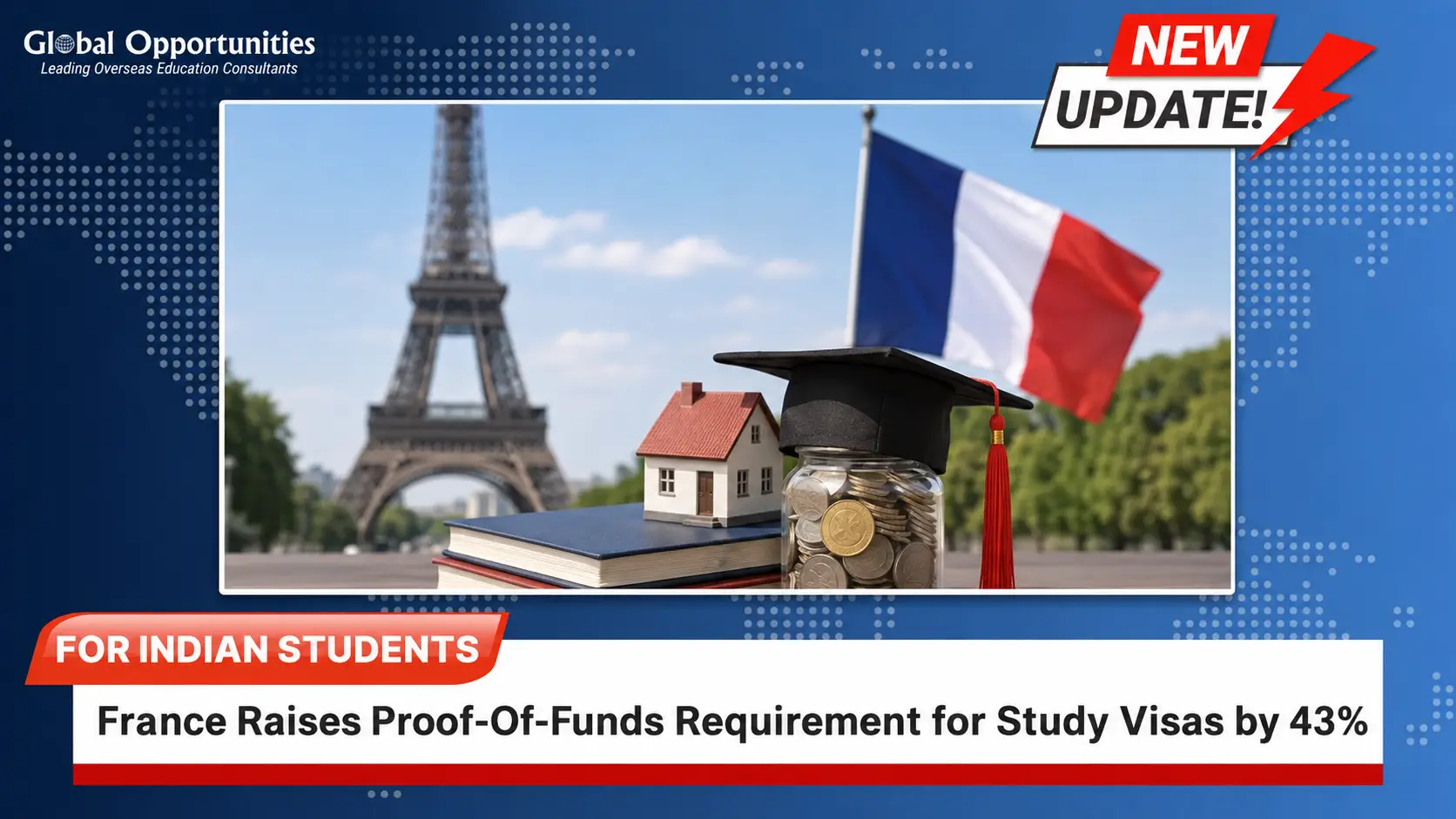
International students planning to study in France face higher financial requirements. The French government has officially raised the minimum required financial resources for a France study visa from €615 per month to €877.50 per month.
The revised limit is a 43% increase—the first significant amendment to the financial criteria for students in nearly 20 years. The amendment has an immediate effect on those applying through Campus France and France-Visas for long-term visas (Visa de Long Séjour valant Titre de Séjour / VLS-TS).
Key Financial Figures & Breakdown
- Monthly Living Requirement: An applicant has to provide proof of maintaining a minimum of €877.50 each month.
- Annual Financial Proof (Academic Year): Applicants will be required to provide proof that they have a minimum of €8,775 during their 10-month academic period in accordance with the new regulation (as compared to the previous requirement of €6,150). The amount needed for a 12-month study in France will increase to €10,530 (previously €7,380).
- Tuition Fee Coverage: The monthly amount merely fulfils minimum living expenses; separate official financial proof for payment of tuition fees will have to be provided.
- Effective Date: The introduction of the new regulation concerning financing starts on August 1, 2026, for all long-term visa applications.
Policy Rationale: Legal Linking to the SMIC Wage Index
The abrupt shift from €615 to €877.50 stems from French decree adjustments linking student living-cost requirements directly to the national minimum wage—the Salaire Minimum Interprofessionnel de Croissance (SMIC).
- The 47% Formula: The new financial threshold is set at 47% of France’s gross monthly SMIC.
- Dynamic Indexing: Because it is indexed to the SMIC rather than fixed as a static number, the minimum threshold will automatically adjust alongside future national minimum wage increases.
Acceptable Forms of Financial Proof
Consular authorities and Campus France require clear, verifiable documentation to validate living funds for a France study visa:
- Personal Bank Accounts: Bank statements showing a steady liquid balance covering the full duration of stay. Consulates generally examine 3 to 6 months of transaction history; sudden lump-sum deposits without clear source attribution can trigger visa delays or rejections.
- Financial Guarantors: An official sponsorship affidavit accompanied by the guarantor’s tax returns (ITR), payslips, and verified bank statements.
- Scholarships & Grants: Official award certificates from government schemes (such as Eiffel Excellence, Charpak, or Erasmus Mundus) or university grants. If the scholarship covers less than €877.50 monthly, the student must prove supplementary funding for the remaining gap.
- Sanctioned Education Loans: Official sanction letters issued by recognised banking or financial institutions.
Additional Administrative Updates for International Applicants
The increase in proof-of-funds coincides with larger operational changes for overseas students studying in France:
- Etudes en France (EEF) Fee Increase: In regions where the EEF system is operational (like India), administrative registration fees have also gone up along with visa amendments (eg from ₹18,500 to ₹20,000).
- Student Life & Campus Contribution (CVEC): Students have to plan for the CVEC fee, which must be paid before they go to university.
- Validation & Residence Formalities: When the students arrive in France, they have to validate their France study visa online on the ANEF portal within a period of 3 months and pay the e-stamp tax along with it.
Why It Matters & Strategic Context
This alteration comes hand-in-hand with the recent changes in the tuition fees for non-European Union learners within the framework of the ‘Choose France for Higher Education’ approach. Contrary to how popular destinations, such as Canada and Australia, are facing more difficult visa caps and changes in education policies concerning education, France remains one of the first destinations for studying abroad due to its growing number of programs taught in English and relatively low cost of education.
However, future students must think twice about their expenses. The cost of living in the big cities, such as Lyon, Paris, and Marseille, is rather high because of the high economic standards. Students worldwide who possess the visa ‘VLS-TS’ are allowed to work part-time according to the law, with the total number of work hours having to be less than 964 hours per year, which is approximately 60 per cent of the working hours each year.
How can GOPL help?
With more than two decades of experience in the study abroad sector, Global Opportunities Pvt. Ltd. should definitely be your next step if you’re planning your higher education abroad. Our experts specialise in the end-to-end process of profile assessment, university shortlisting, financial documentation preparation, and visa processing, which will help you map out your entire study abroad journey efficiently.