Australia Tightens Migration Rules With New Restrictions on Student Family Members
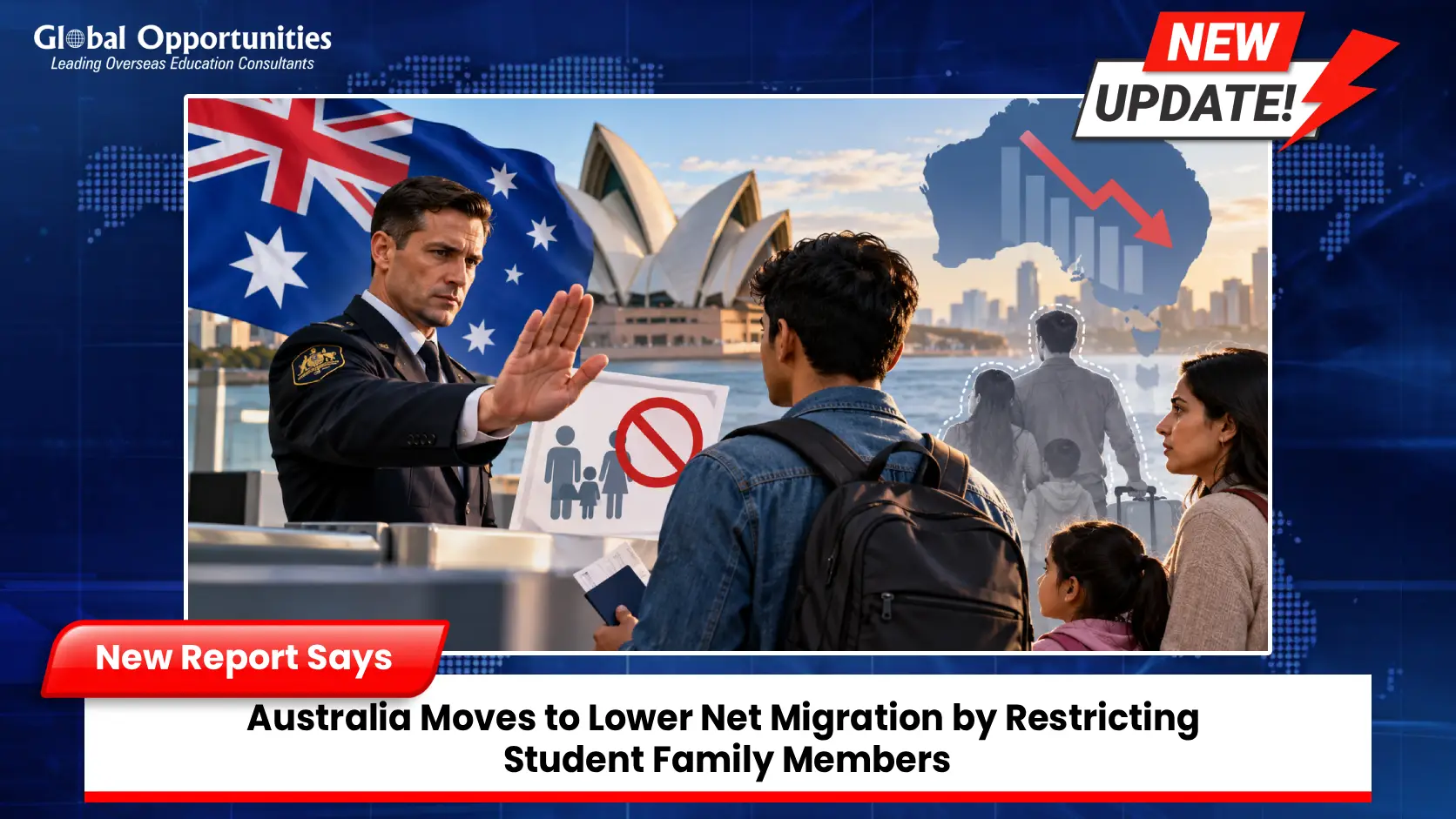
Australia has announced an extensive assortment of immigration and international education reforms intended to lower net overseas migration. Home Affairs and Immigration Minister Tony Burke presented the reforms in a speech at the National Press Club, signalling a change in the country’s foreign student enrolment policies and visa pathways.
The government’s target is to drop net overseas migration from around 292,000 to 245,000 by the 2026/27 financial year and to 225,000 by the 2027/28 financial year. International education reforms will be a major instrument in achieving those targets.
Key Policy Changes at a Glance
The recently released regulations impose various stringent requirements to reduce the chances of long-term stay extensions and limit the occurrence of non-educational migration.
- Student Dependants Restrictions: Most secondary applicants for Australian student visas will no longer be allowed to join primary visa holders. Similar to the recent UK regulations, family members of international students, including those studying coursework, will be banned from living and studying in Australia.
- Exceptions: Dependants may still qualify for students pursuing their PhDs, students involved in the Pacific or ASEAN program and government-sponsored students from abroad.
- Present Visa Holders: Minister Burke has assured that families that are currently living in Australia on a valid visa will not be separated and will be allowed to stay in Australia until their current visa expires or they get permanent residency status.
- Course and Education Provider Transfers: Students who wish to change their education provider or course must submit a new application for an Australian student visa unless there are exceptional circumstances.
- Ending “Visa Hopping”: Students who want to continue their stay by studying subsequently must show upward progress in their qualifications (i.e., go from Bachelor to Masters).
- Restrictions to Visitor Visa: The “no further stay” condition is going to be put on visitor visas to stop visitors from using visitor visas as a means to extend their stay.
- Working Holiday Maker Program: The Working Holiday Maker Program will introduce a ballot for extensions in the second and third years based on the requirement of regional work.

Industry Impact and Regional Dynamics
The limitations on secondary applications are expected to have a major impact on international recruitment, especially from South Asia. The figures reveal that South Asian countries accounted for 70% of student visas granted to applicants for overseas dependants—over 10,000 dependants coming from Nepal, Bangladesh, Bhutan, India, and Sri Lanka. Of the total of 337,400 student visas granted from July 2025 to June 2026, 46,000 were granted to dependents.
Reactions across Australia’s education sector have been mixed:
- Research & University Groups: Associations from research-reliant sectors like the Group of Eight have come in support of PhD exemption as they believe that exceptional PhD students are the backbone of Australia’s progress.
- Recruitment & Market Implications: According to Phil Honeywood, the CEO of the International Education Association of Australia (IEAA), Australia stands to lose bright minds to rival nations and territories such as Germany, France, Ireland and New Zealand. Rising visa application charges, slow processing of applications, and strict restrictions on dependents will repel bona fide applicants.
- Commencement Targets: Universities Australia has shared that there has already been an 8% drop in new international enrolments this year compared to last year, falling short of government targets.
Looking Ahead
With the implementation of these new policy measures, various international stakeholders involved in education – prospective international students, education agents and institutional partners – will be required to modify their plans and advisory practices. Although Australia continues to be perceived as one of the leading countries offering high-quality education and excellent research opportunities, the possibilities for studying accompanied by family members and changing programs will be much more limited in the future.
With more than two decades of experience in the study abroad sector, Global Opportunities Pvt. Ltd. should definitely be your next step if you’re planning your higher education abroad. Our experts specialise in the end-to-end process of profile assessment, university shortlisting, financial documentation preparation, and visa processing, which will help you map out your entire study abroad journey efficiently.